Site under construction — check back daily for updates
Robotic Tooling
Rebar Gripper
A custom robotic end-effector developed to grip, position, and scan rebar within a coordinated robotic assembly workflow.
Type
Robotic End-Effector
Robot
UR10e
Application
Rebar Handling
Sensing
Intel RealSense D435
Fabrication
SLS Nylon 3D Printing
Pneumatics
Electronics
01
Tool Assembly
The gripper combines a pneumatic gripping mechanism, custom locating geometry, a robot interface, and an integrated depth camera within a single robotic tool.
Scroll through the exploded assembly to reveal the relationship between the tool body, pneumatic components, gripping mechanism, RealSense camera, and interfaces connecting the gripper to the robot.
02
Design Problem
The tool needed to securely handle long rebar members while maintaining access to the intersections where robotic tying and assembly would occur.
Unlike a compact pick-and-place object, a long rebar member amplifies small changes in position and orientation at the gripper. The tool therefore needed to establish a stable connection to the bar while keeping the member predictable during robotic movement.
Clearance around the gripping point was equally important. The end-effector needed to remain compact enough for the held member to approach other bars, connection locations, and the separate robotic wire-tying tool.
03
Gripping + Pneumatic Actuation
The gripping geometry locates the rebar along a defined centreline while pneumatic actuation provides the force required to secure the member during movement.
The jaw profile was designed around the circular section of the rebar. As the gripper closes, the member is guided into a repeatable position rather than being clamped between two unrestricted flat surfaces.
Pneumatic actuation allows the mechanism to remain compact and mechanically simple while providing a rapid gripping action that can be triggered directly within the robotic sequence.
04
Camera Integration
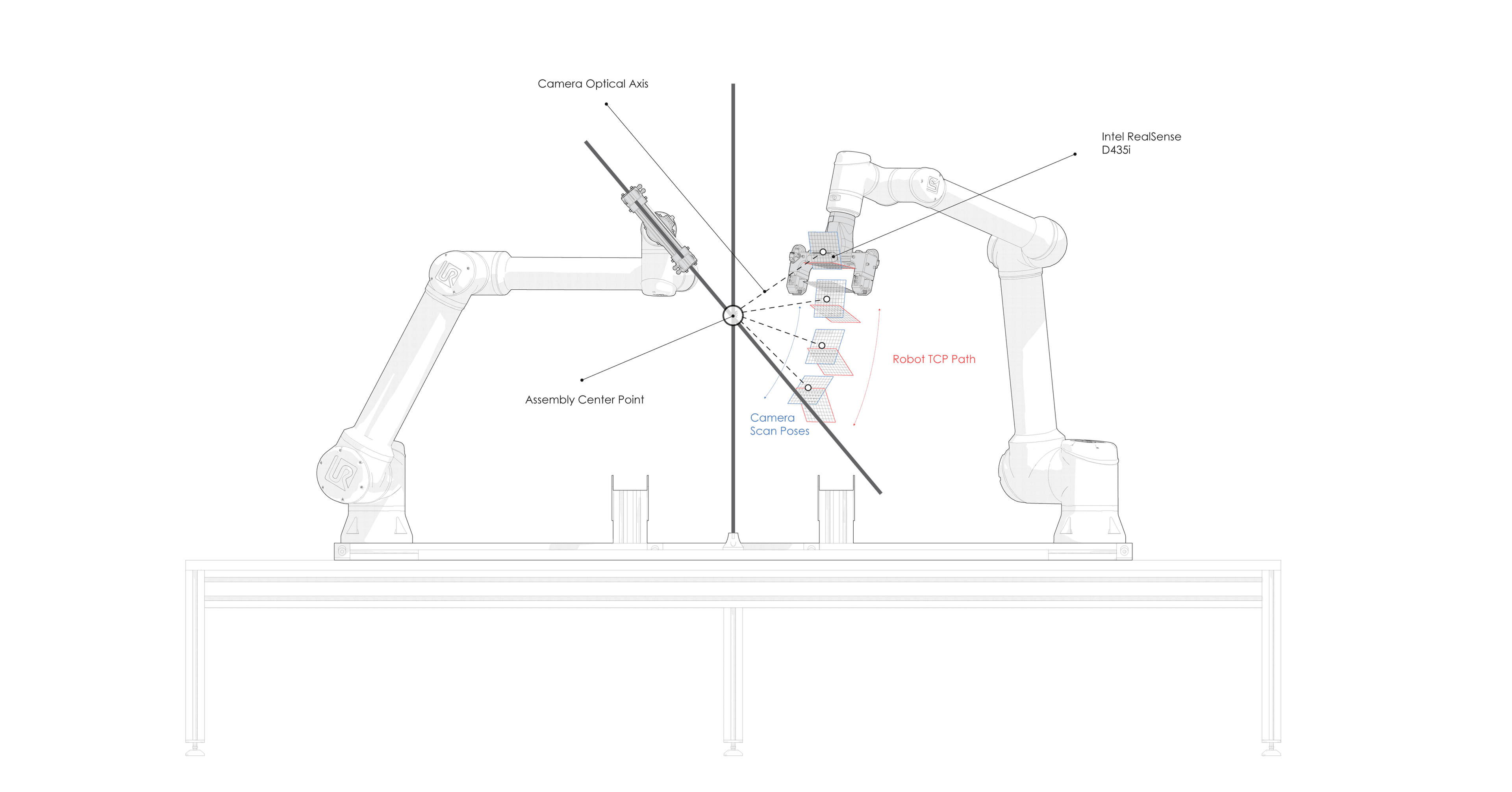
An Intel RealSense D435 is integrated directly into the end-effector, allowing the robot to reposition the camera around the physical assembly.
Mounting the sensor to the robot wrist allows scanning positions to be defined as robot poses rather than relying on a separate fixed camera setup.
The robot can therefore move the RealSense around a connection and capture localized point-cloud data from several viewpoints after assembly.
05
Camera Transform + Robot Integration
The known relationship between the robot, tool, and camera allows each scan to be transformed into the robot base coordinate system.
The position of the RealSense is defined relative to the gripper frame. As the UR10e moves between scanning poses, the corresponding robot transform is used to reorient each captured point cloud.
This brings scans captured from different viewpoints into a common coordinate system where they can be aligned with the digital assembly geometry.
06
Tool Body + Fabrication
The final end-effector was developed from SLS-printed components through mechanical, pneumatic, and electrical assembly before being tested on the UR10e.
The custom tool components were produced through SLS printing, removed from the powder bed, depowdered, and sandblasted before the mechanical components and pneumatic hardware were assembled.
Electrical connections were soldered and routed through the tool alongside the pneumatic lines and camera hardware. The completed assembly was then mounted to the robot and tested through rebar pickup and placement.
Main Research Project