Site under construction — check back daily for updates
Additive Manufacturing
Lignin 3D Printing Extruder
A custom screw-based extrusion system developed to process, heat, and deposit lignin-based particulate material for additive manufacturing.
Type
Custom Extrusion System
Material
Lignin
Drive
NEMA 17 / 6:1 Gearbox
Process
Screw Extrusion
Fabrication
CNC Machining
3D Printing
Custom Electronics
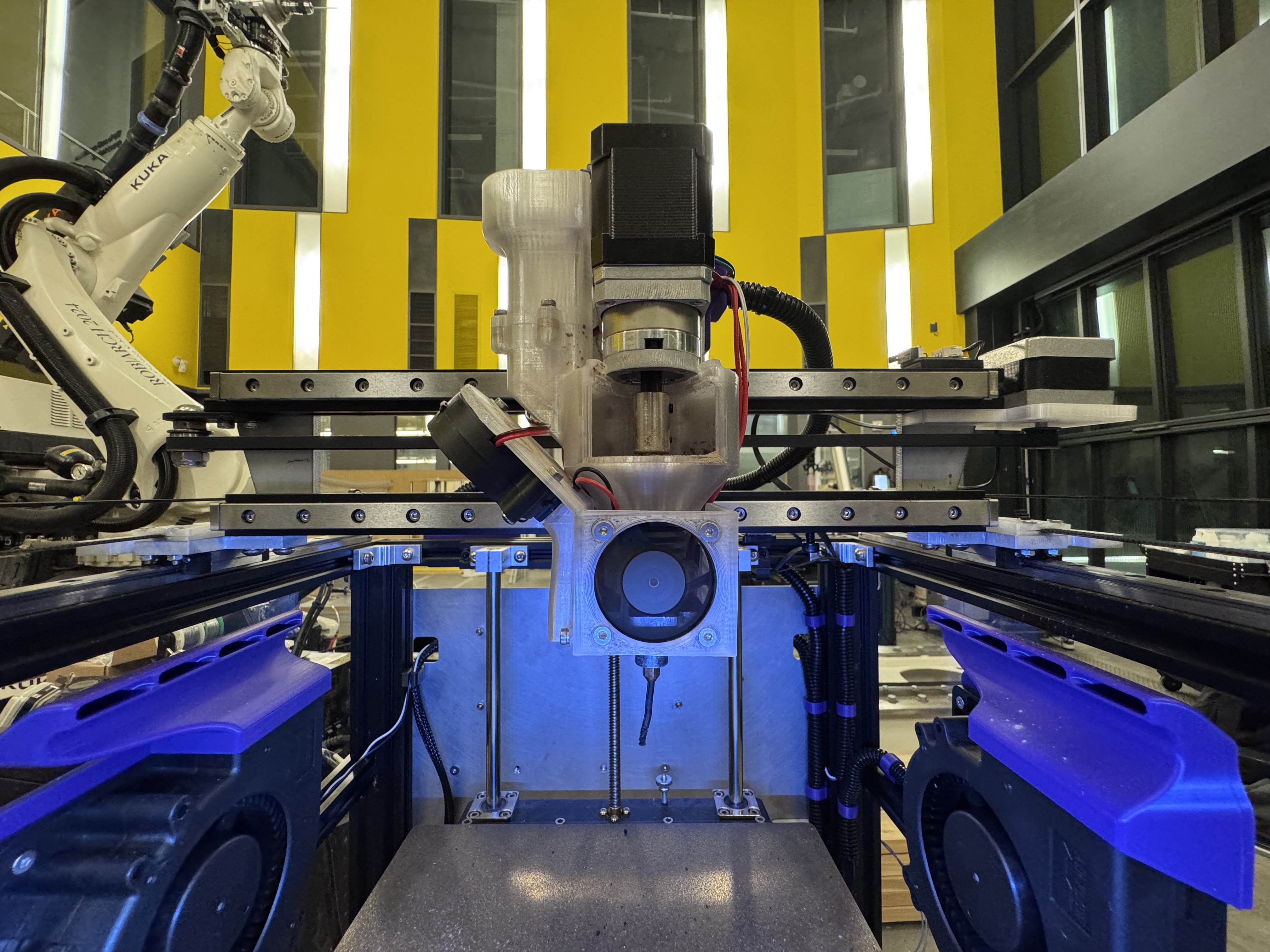
Project Context
The extrusion system was developed as part of research into reversible wood composites, exploring how lignin-based materials could be processed and fabricated through custom additive manufacturing hardware.
Reversible Wood Composites ↗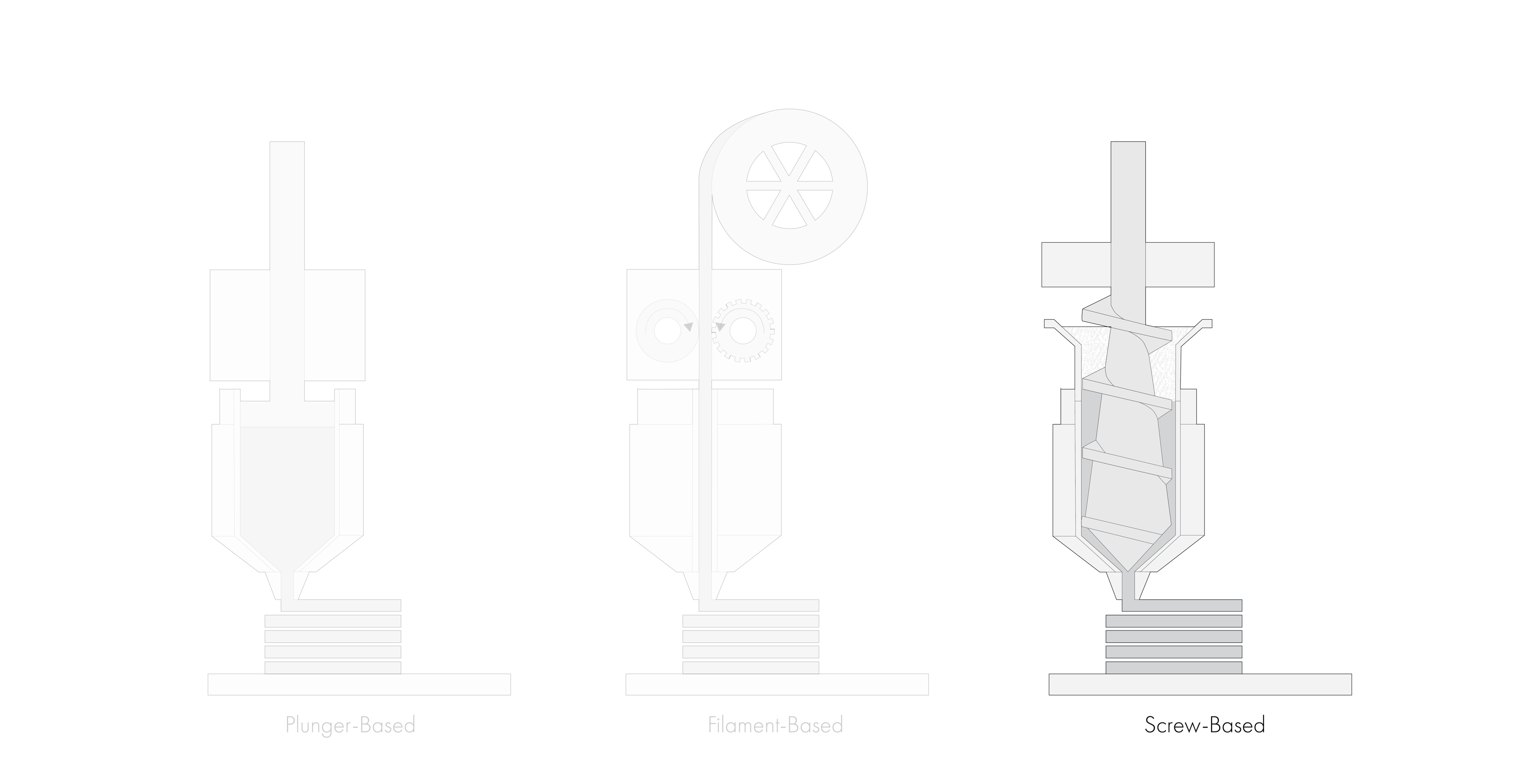
Plunger, filament, and screw-based extrusion strategies.
01
Extrusion Strategy
Screw-based extrusion enables continuous material transport without requiring the feedstock to first become a conventional filament.
Plunger, filament, and screw-based extrusion strategies were considered during development. Each presents a different relationship between material preparation, transport, and deposition.
A screw-based system was selected because rotational shear allows particulate material to be continuously conveyed, mixed, compressed, and processed through the extrusion assembly.
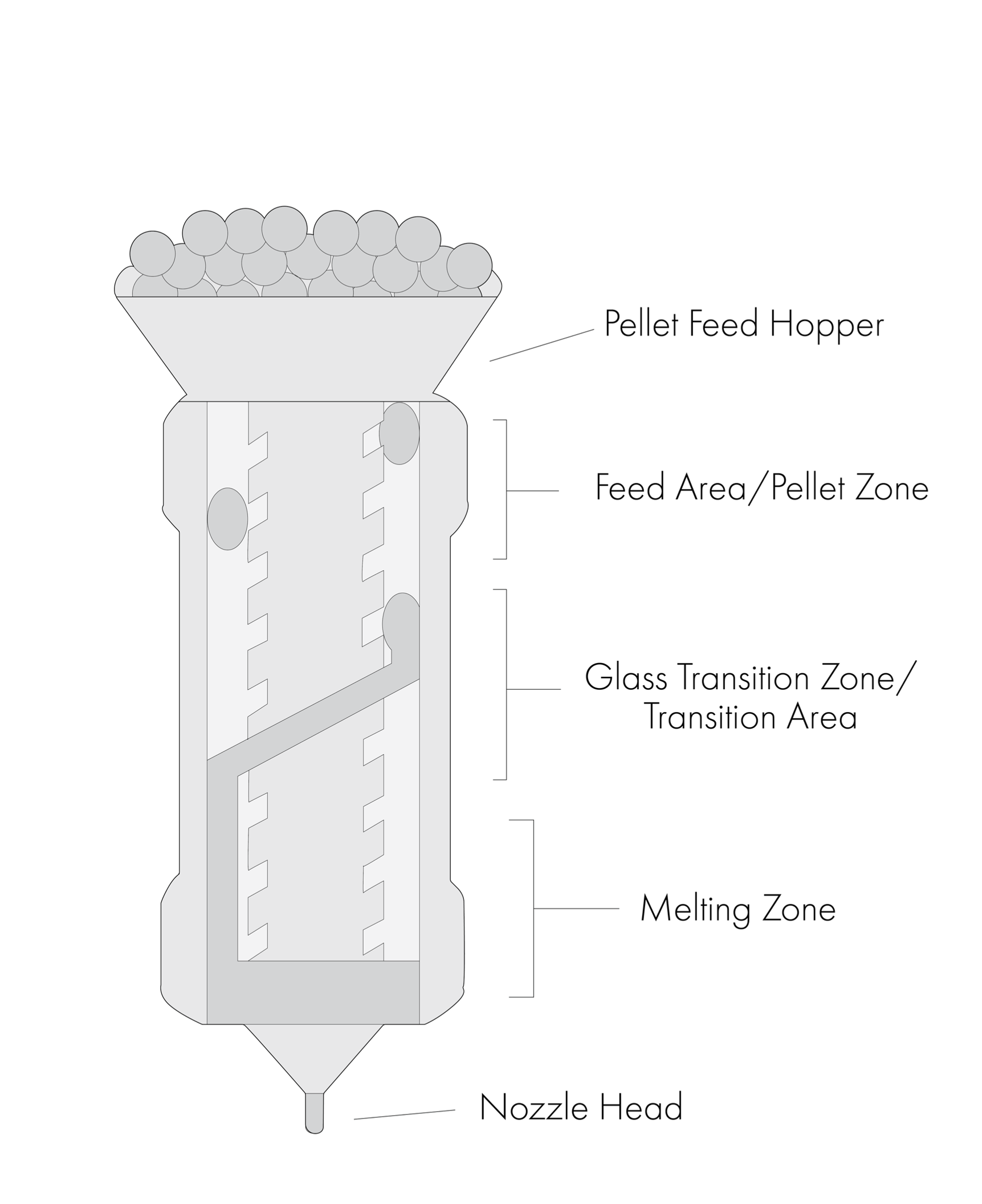
Material progression through the screw extrusion system.
02
Screw Extrusion
A rotating auger moves material from the hopper through a controlled thermal and mechanical progression before deposition.
Material enters through the feed hopper and is transported by the rotating auger. Thermal input and mechanical shear soften and homogenize the material while generating pressure toward the extrusion nozzle.
The system was developed around continuous material conveying and in-situ mixing, allowing pelletized or particulate feedstocks to be processed without a separate filament-making stage.
03
Extruder Assembly
The extrusion head combines material feeding, auger-driven transport, heating, cooling, and deposition into a single assembly.
The assembly combines a geared stepper drive, material hopper, paddle mixer, custom auger, thermal transition, heat block, and dedicated cooling into a modular system.
Drive
NEMA 17 Stepper Motor
Reduction
6:1 Gearbox
Coupling
8 mm Coupler
Material Feed
Hopper + Material Chute
Mixing
Paddle Mixer
Transport
Custom Auger Screw
Heating
Custom Heat Block
Cooling
Heat Break + Part Cooling
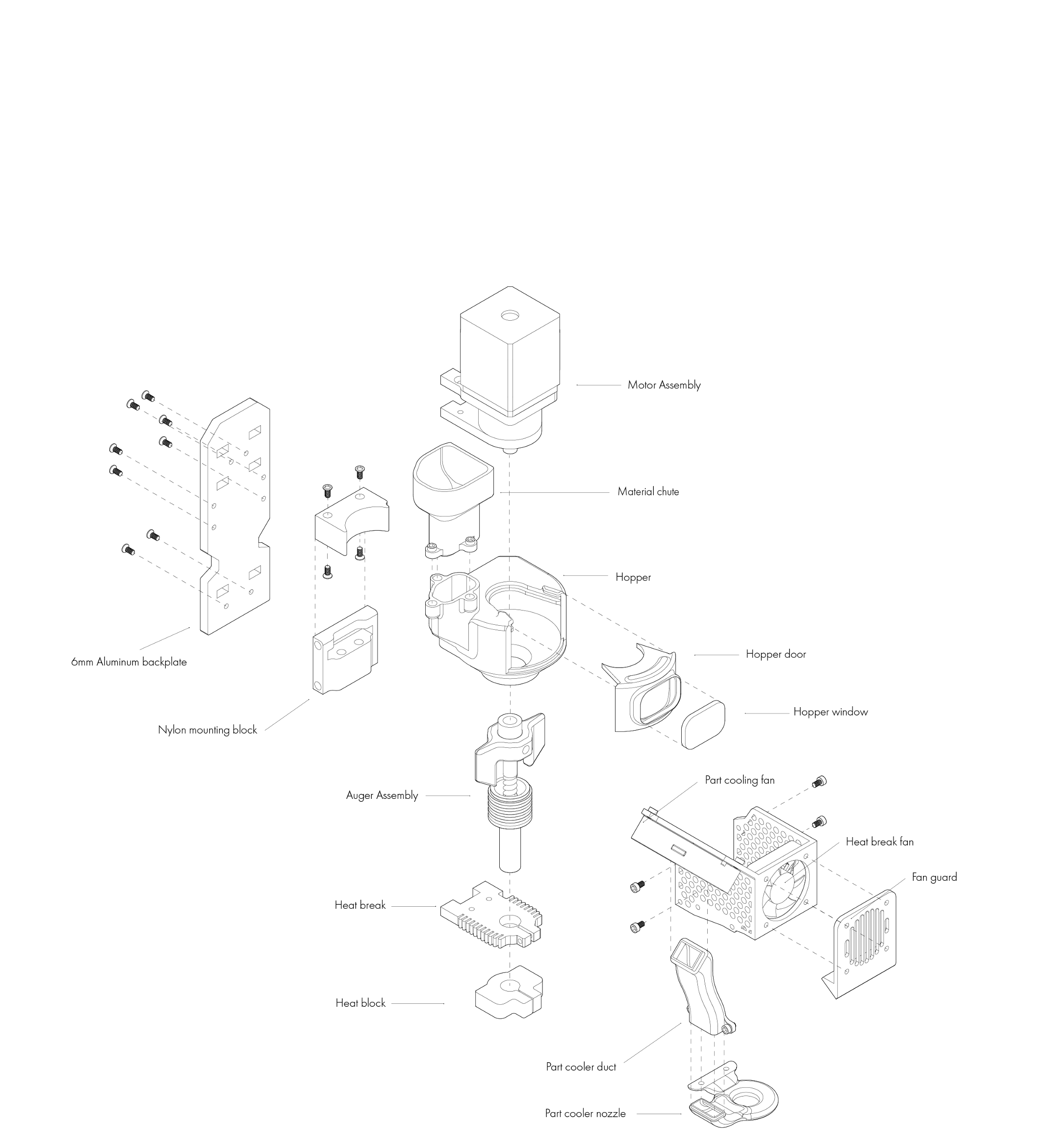
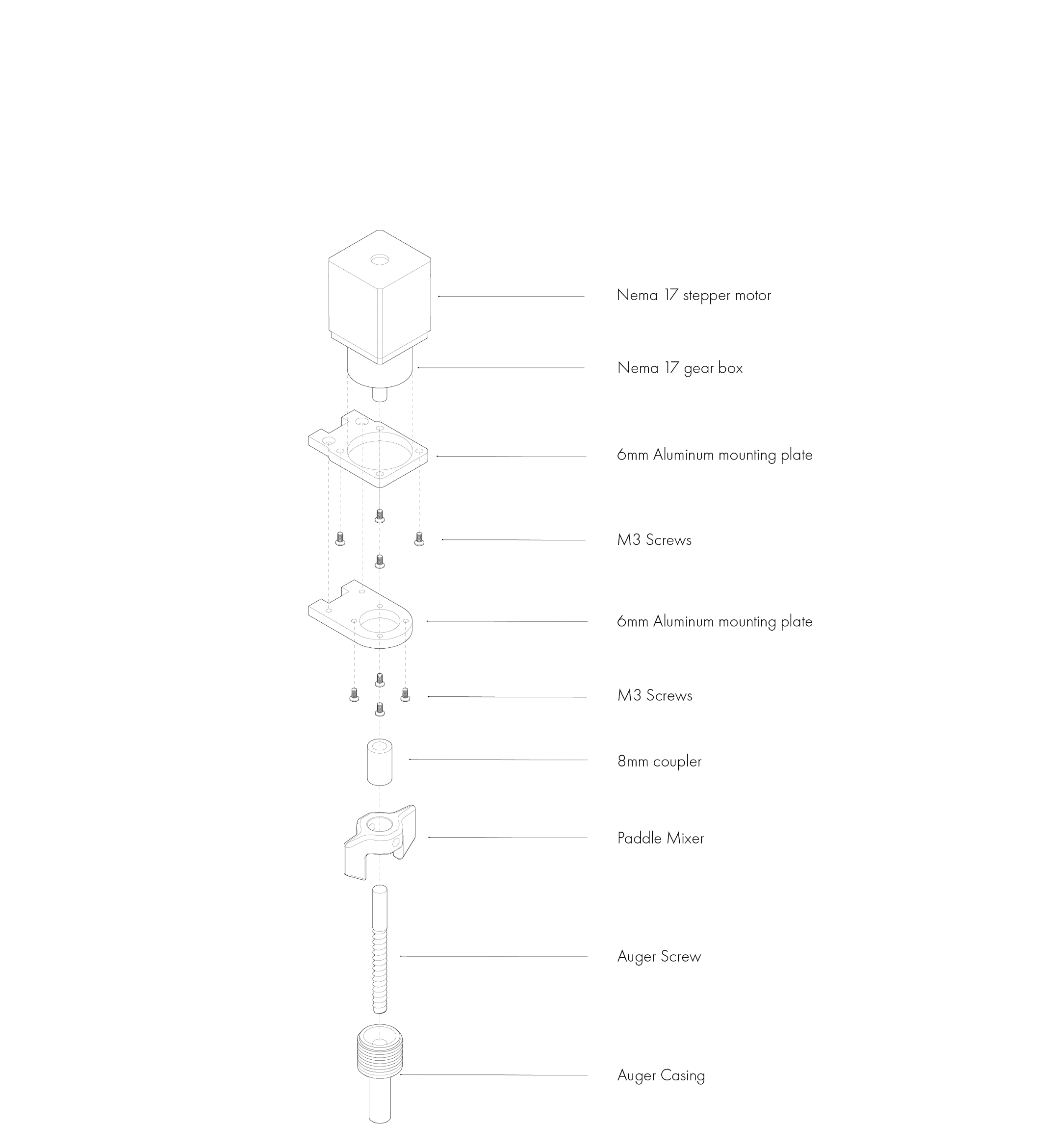
Drive, coupling, mixer, auger, and casing assembly.
04
Drive + Mixing
A geared stepper drive powers both material mixing and continuous auger transport through the extrusion head.
The drive assembly uses a NEMA 17 stepper motor with a 6:1 gearbox connected to the extrusion assembly through an 8 mm coupler.
A paddle mixer and custom auger screw form the primary material handling system. Material entering from the hopper is mixed and transported toward the heated region by the rotating assembly.
05
Heating + Sensing
A custom heat block thermally activates the material immediately before extrusion.
The heating assembly uses two 90 W ceramic heater cartridges integrated into the custom heat block. Two NTC thermistors provide temperature sensing for the system.
A heat break and dedicated fan separate the heated extrusion region from the upstream material-handling assembly. A separate part-cooling fan directs airflow toward deposited material.
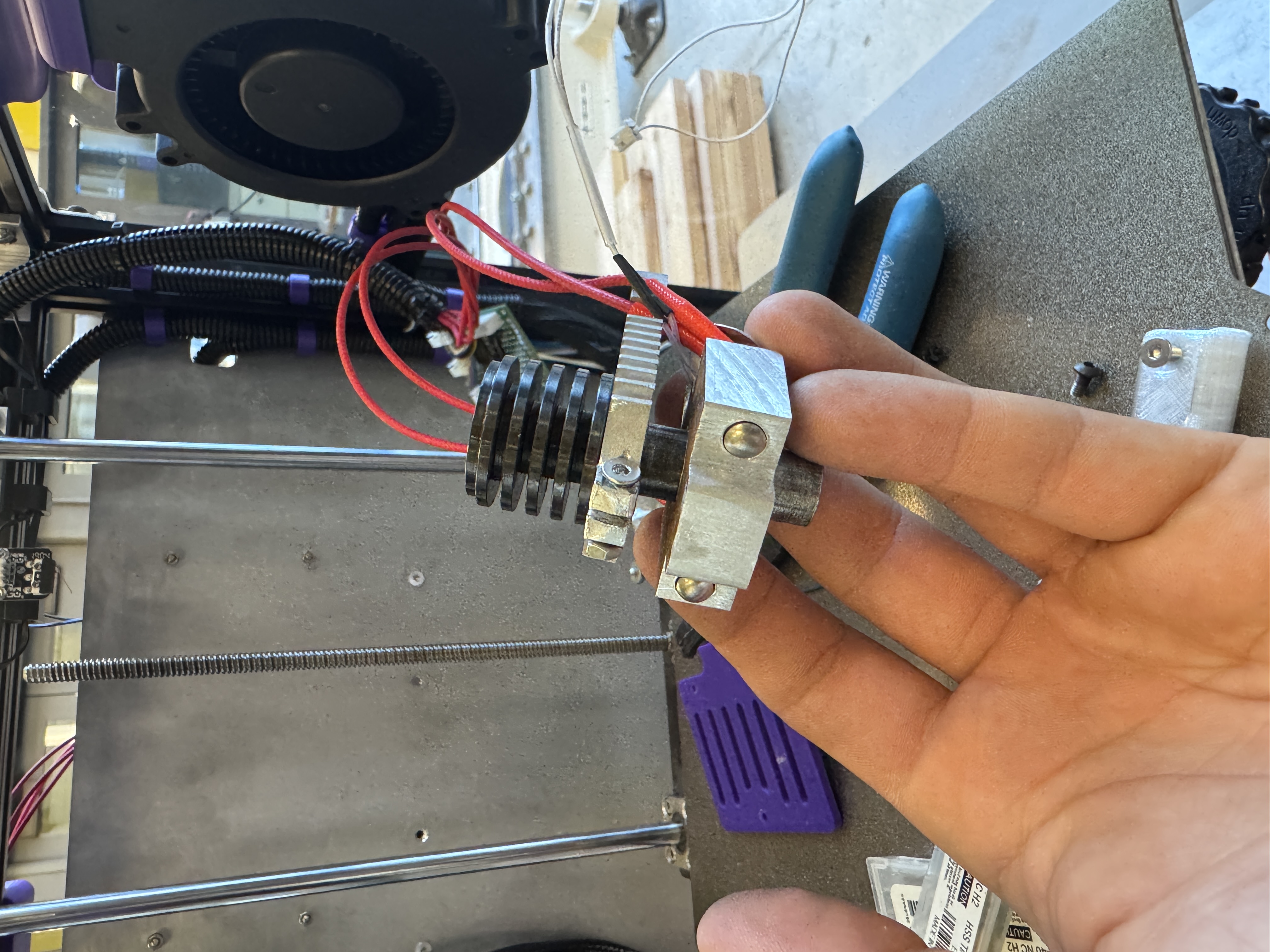
Custom fabricated heating assembly.
06
Material Development
Developing the extrusion system required the lignin feedstock and mechanical hardware to be tested together.
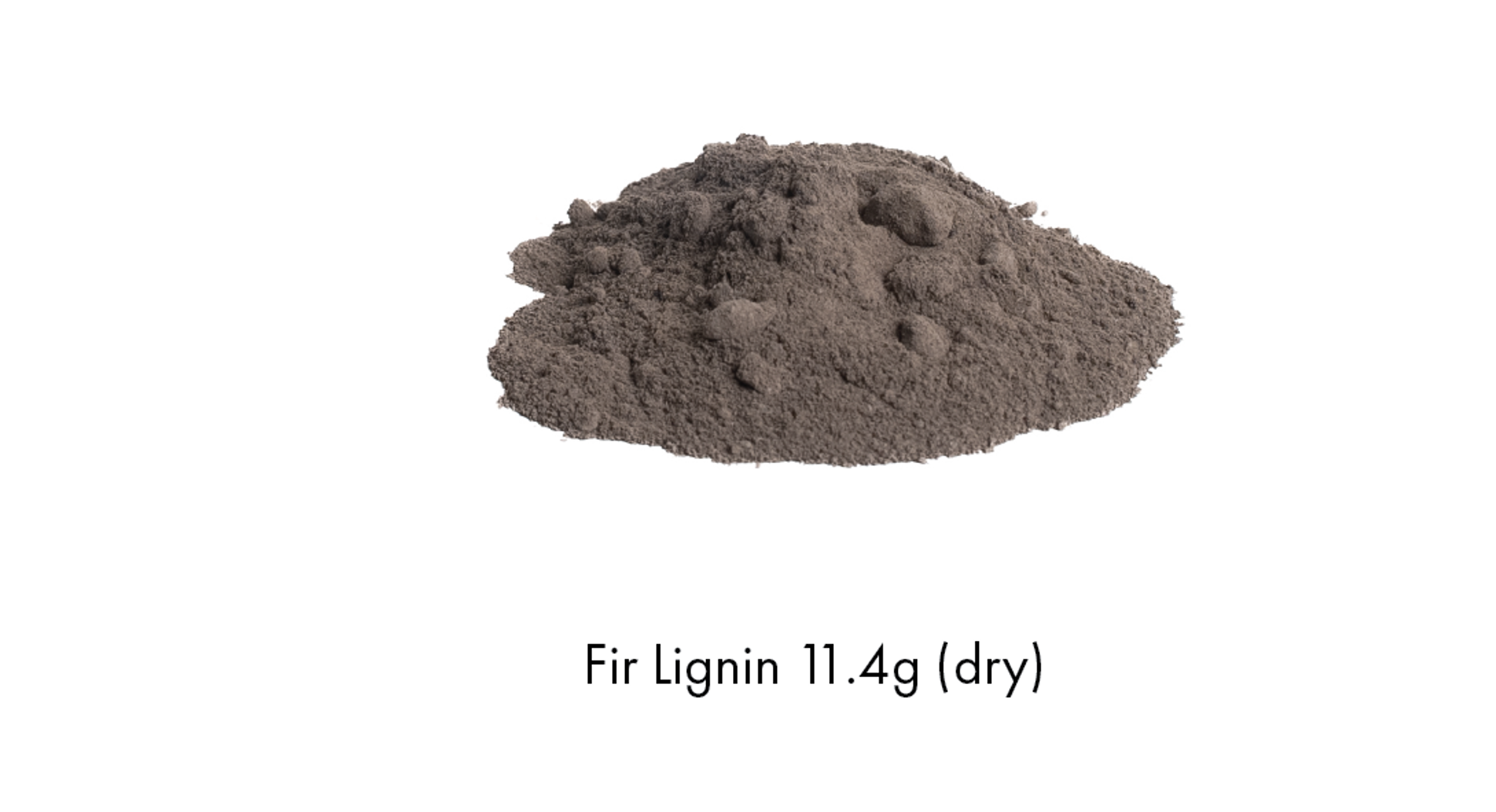
Fir lignin was processed into a fine particulate feedstock suitable for the screw-based extrusion system. Material preparation became an important part of controlling how consistently the lignin entered and moved through the auger.
Changes in particle size, moisture, temperature, and material behaviour directly affected feeding and deposition, requiring the extrusion hardware and material preparation process to develop together.
07
Material Workflow
Lignin is refined, prepared, and thermally processed before it can be deposited as a printable material.
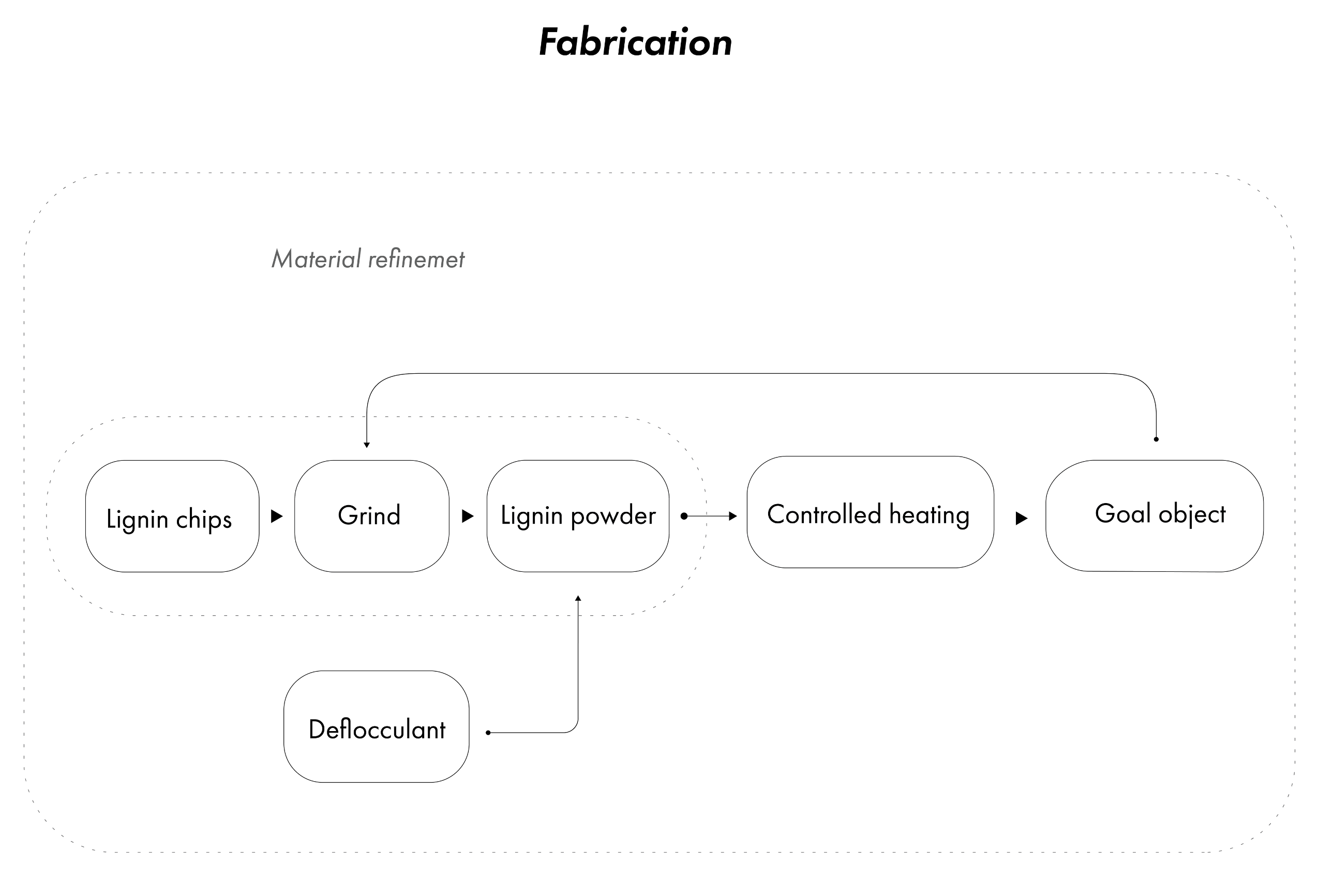
The workflow begins with lignin chips, which are ground into powder before entering the extrusion process. Preparing a consistent feedstock improves material flow through the hopper and screw assembly.
The material is then subjected to controlled heating during extrusion. This creates a continuous loop between material refinement, thermal processing, deposition, and subsequent testing.
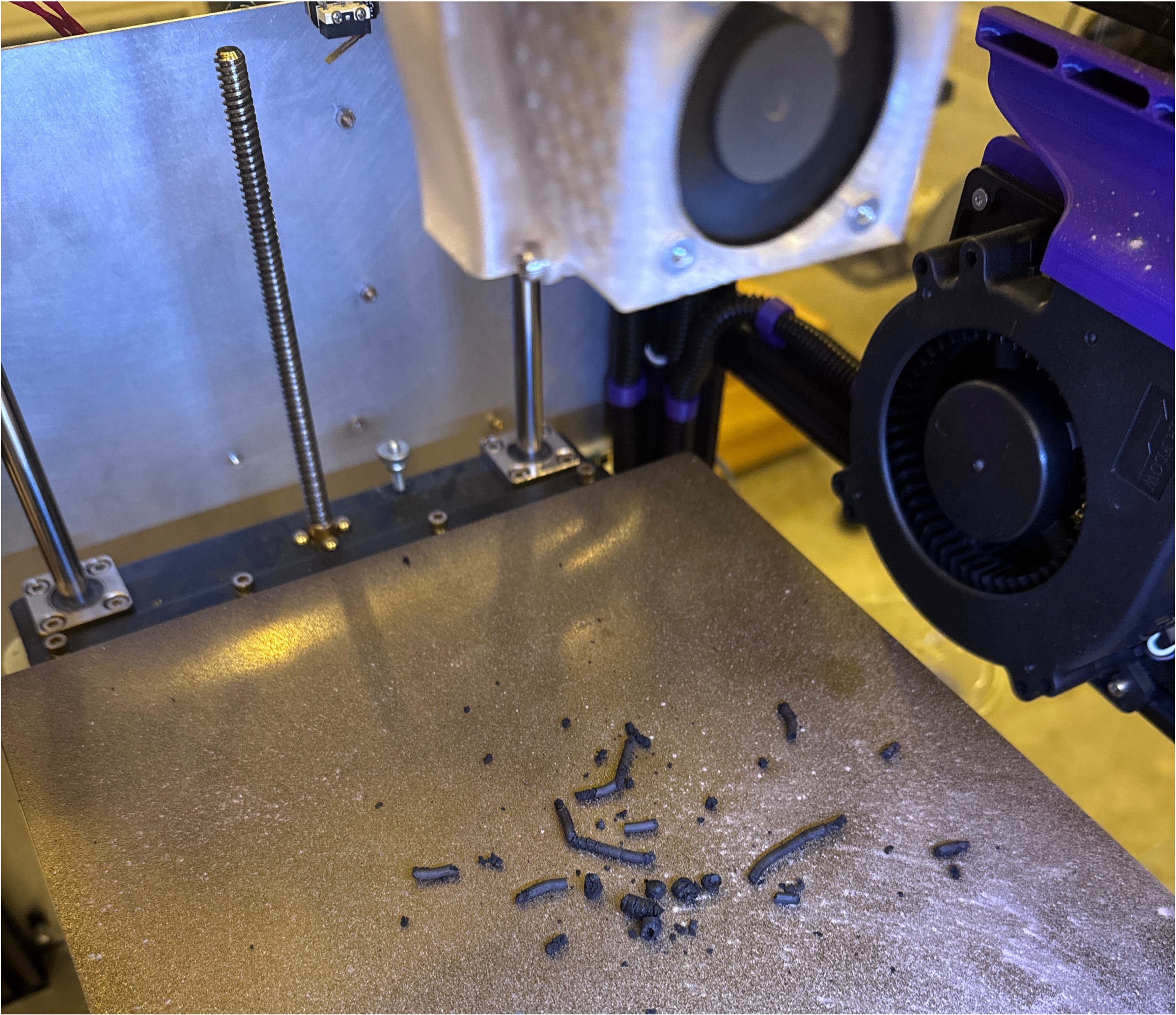
Initial dry lignin extrusion testing.
08
Initial Powder Tests
Dry lignin powder could be conveyed and heated, but it could not form a stable continuous extrusion.
Initial tests introduced lignin powder directly into the hopper without binders or pelletization. The auger successfully transported the powder through the heated extrusion system, confirming the basic operation of the machine.
Extrusion itself remained unstable. Steam became visible at the nozzle and fine particles were intermittently expelled rather than forming a continuous extrudate. The resulting material was brittle, discontinuous, and non-uniform.
09
Material Rehydration
Rehydrating the lignin into a paste significantly improved cohesion and flow through the extrusion system.
Introducing controlled moisture changed how the lignin behaved inside the auger and heated region, allowing the material to move as a more cohesive mass rather than as loose powder.
The revised material condition improved transport and provided a more consistent basis for continued extrusion testing and process development.
10
System Development
The extruder developed as an experimental platform in which material preparation, mechanical transport, thermal control, and deposition could be iterated together.
Rather than adapting lignin to an existing printer, the machine was developed around the behaviour of the material itself. Changes to the feedstock could be evaluated directly against changes to the screw, heating system, and operating parameters.
This created a repeatable framework for continuing material development while retaining direct control over the hardware responsible for conveying, processing, and depositing the lignin.