Site under construction — check back daily for updates
Material Testing Tooling
ASTM Testing
Molds
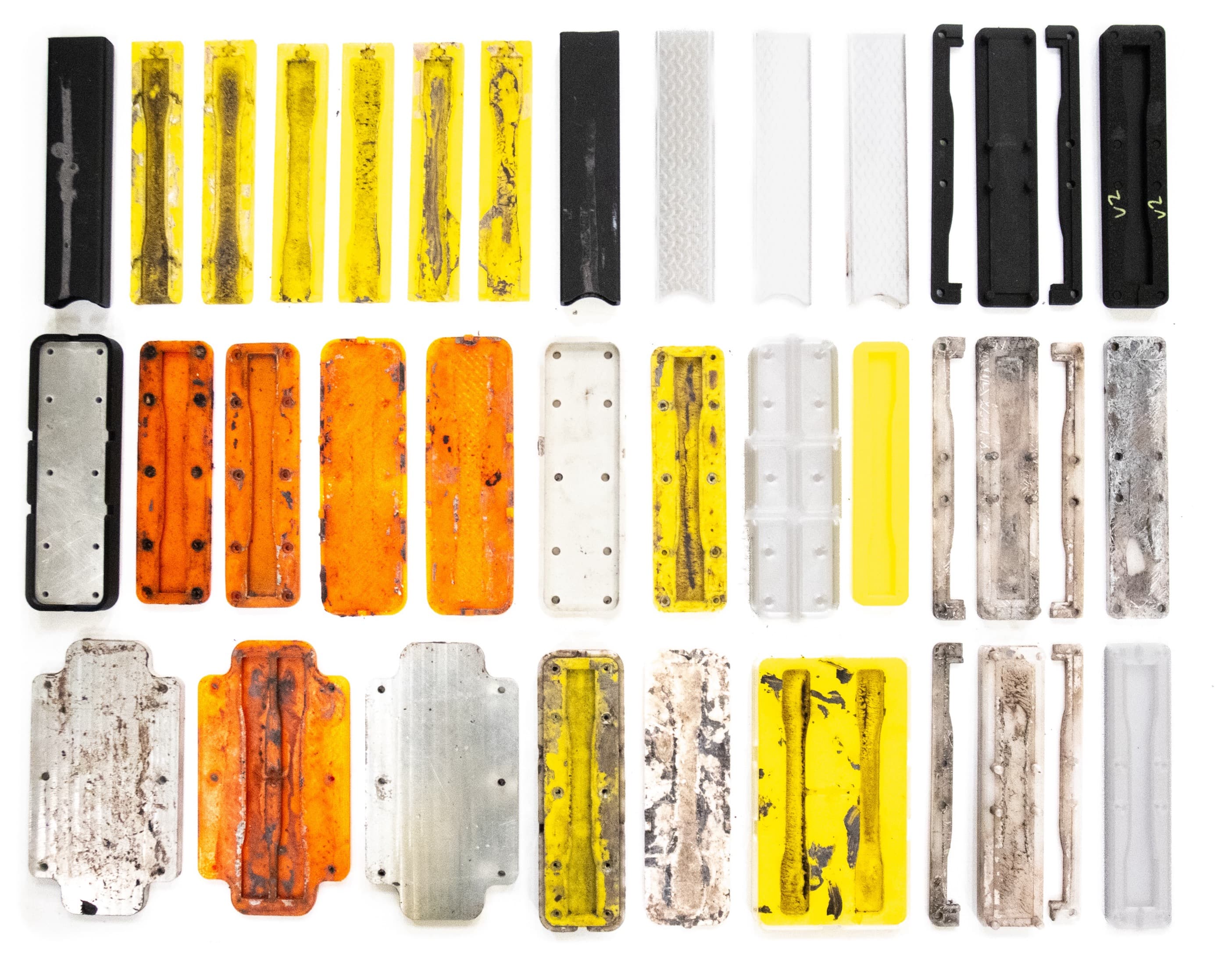
An iterative mold system developed to produce consistent lignin-based specimens for standardized mechanical testing.
Type
Testing Tooling
Standard
ASTM D638
Specimen
Dog-Bone
Tensile Samples
Fabrication
3D Printing
CNC Milling
Final System
Silicone Hybrid Mold
01
Mold Development
The mold system evolved through repeated changes in geometry, orientation, material, and forming strategy.
Mold development responded directly to the behaviour of the lignin-based material during casting, curing, and demolding. Each iteration exposed different limitations in surface quality, consolidation, material flow, and specimen removal.
The objective was to establish a repeatable method for producing controlled specimen geometries suitable for mechanical testing.
02
ASTM Geometry
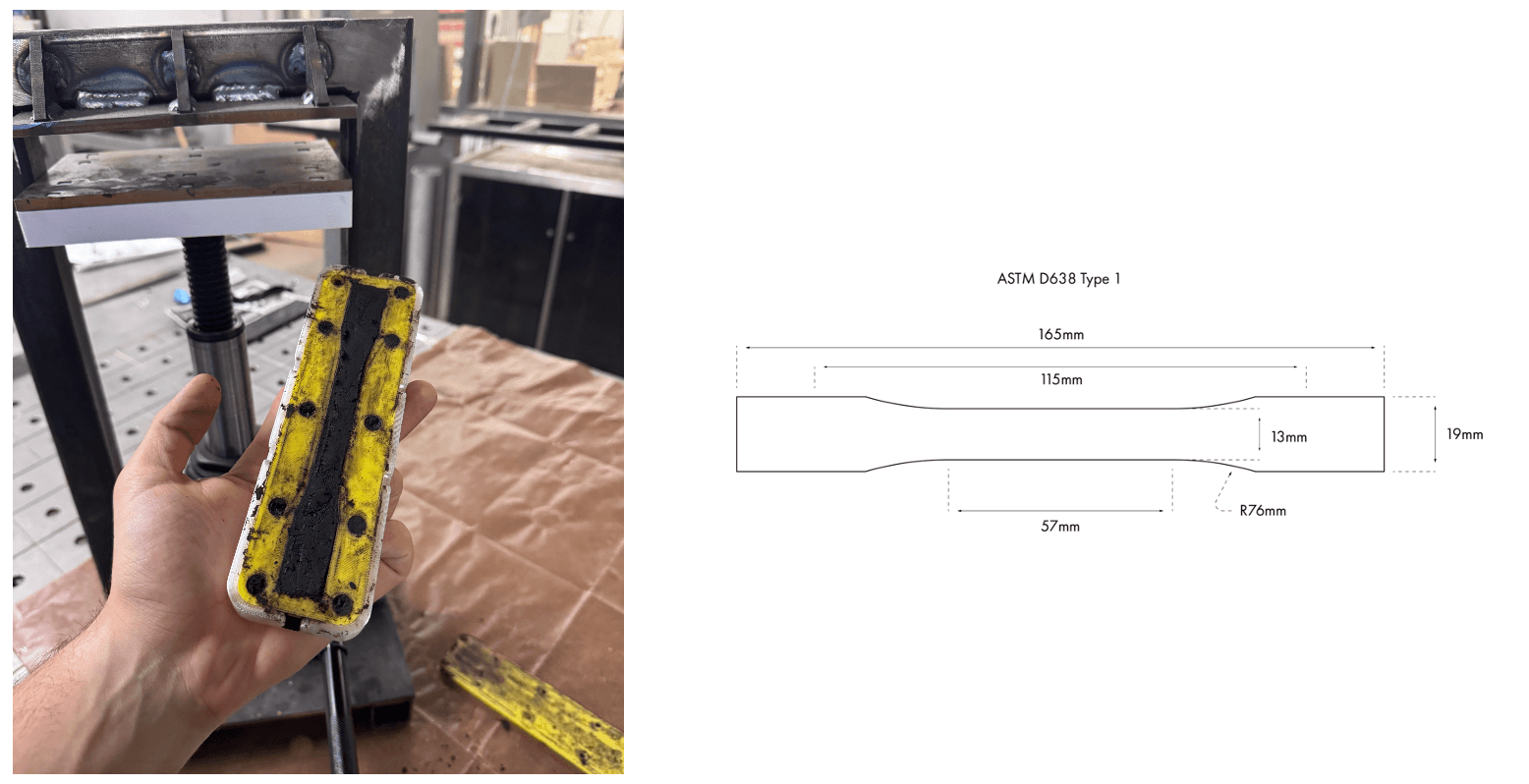
Custom molds were designed around ASTM D638 dog-bone geometry for tensile testing.
ASTM D638 uses a reduced central gauge section with enlarged ends for gripping. The geometry is intended to concentrate deformation within the central region and promote failure away from the grips.
The mold cavities maintained consistent specimen geometry, including a uniform gauge section, reducing dimensional variation between samples and allowing specimens to be tested directly in their as-formed state.
03
Initial Casting
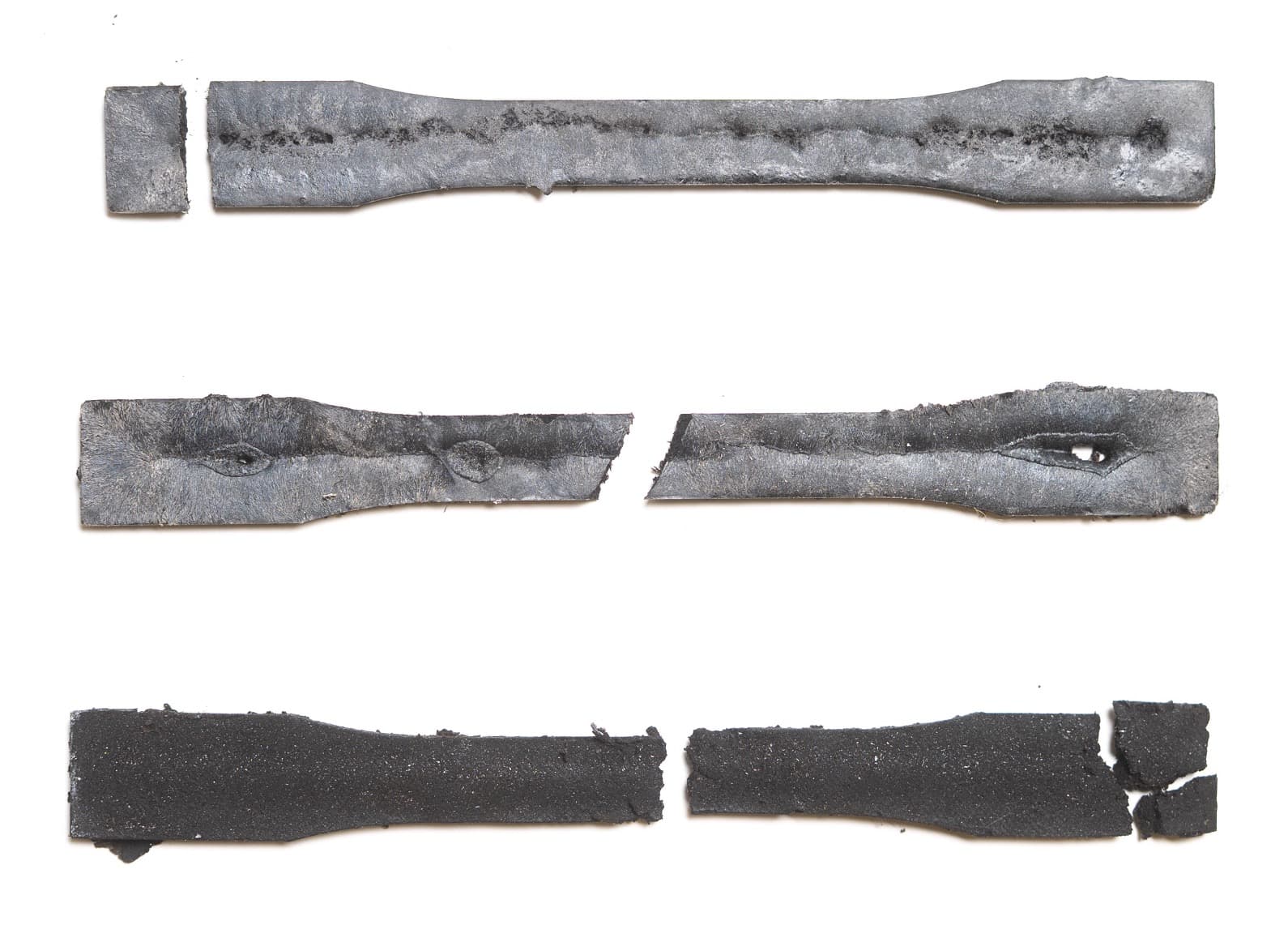
Early horizontal molds established the specimen geometry but revealed problems with consolidation and surface quality.
Initial specimens were poured into horizontal molds and allowed to settle under gravity. While straightforward to cast, the process produced pitting, inconsistent surface finishes, and incomplete consolidation.
These effects were particularly visible on the upper surface of the specimen, showing that gravity casting alone was not producing sufficiently consistent samples.
04
Vertical Casting
Casting orientation was changed in an attempt to improve consolidation through the specimen.
The mold was moved into a vertical configuration to promote more uniform consolidation along the primary axis of the specimen.
The vertical setup instead produced a persistent void at the top of the specimen and uneven curing. Material near the mold interface solidified more quickly while the interior remained under-consolidated.
05
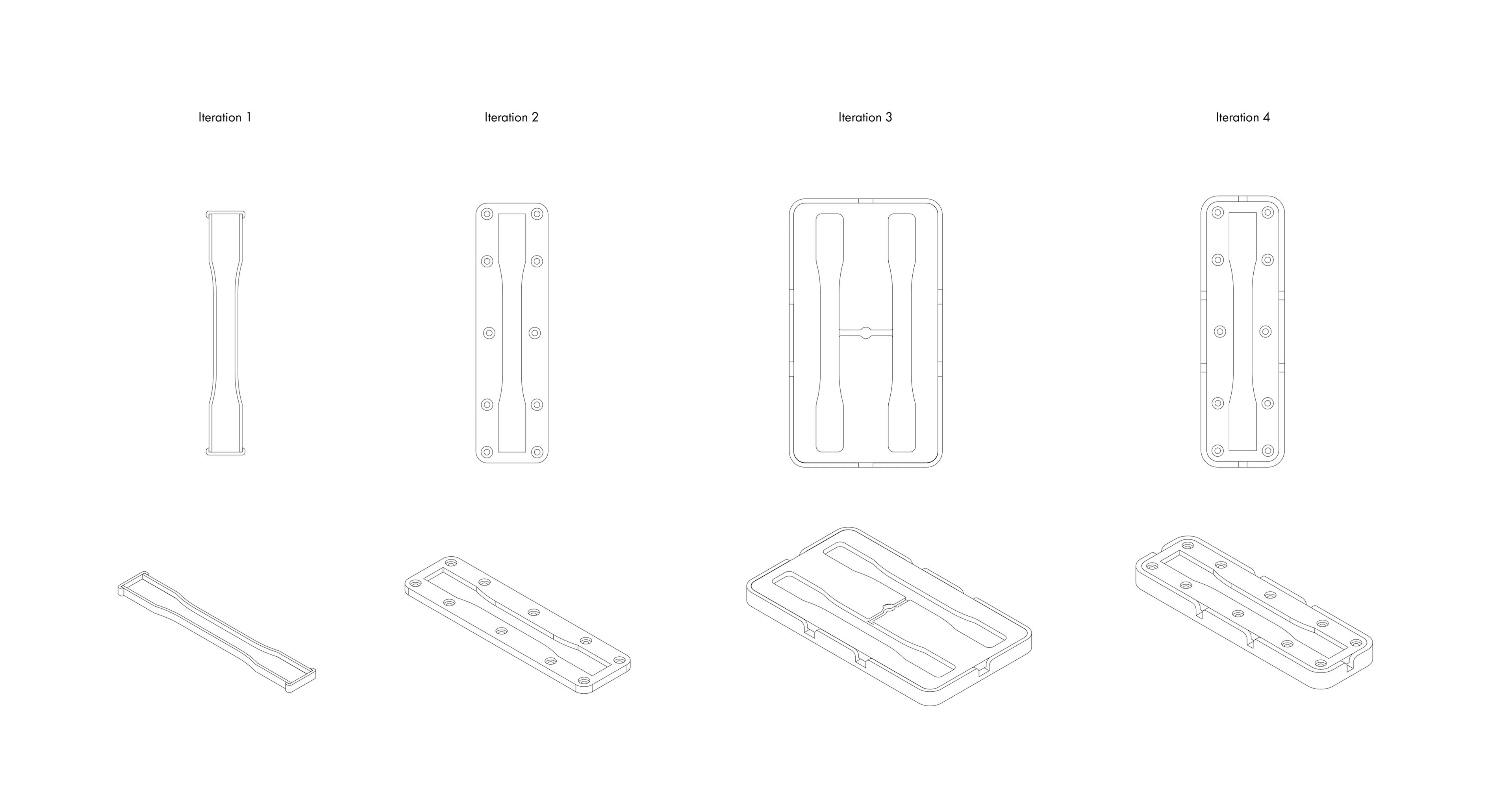
TPU Mold Development
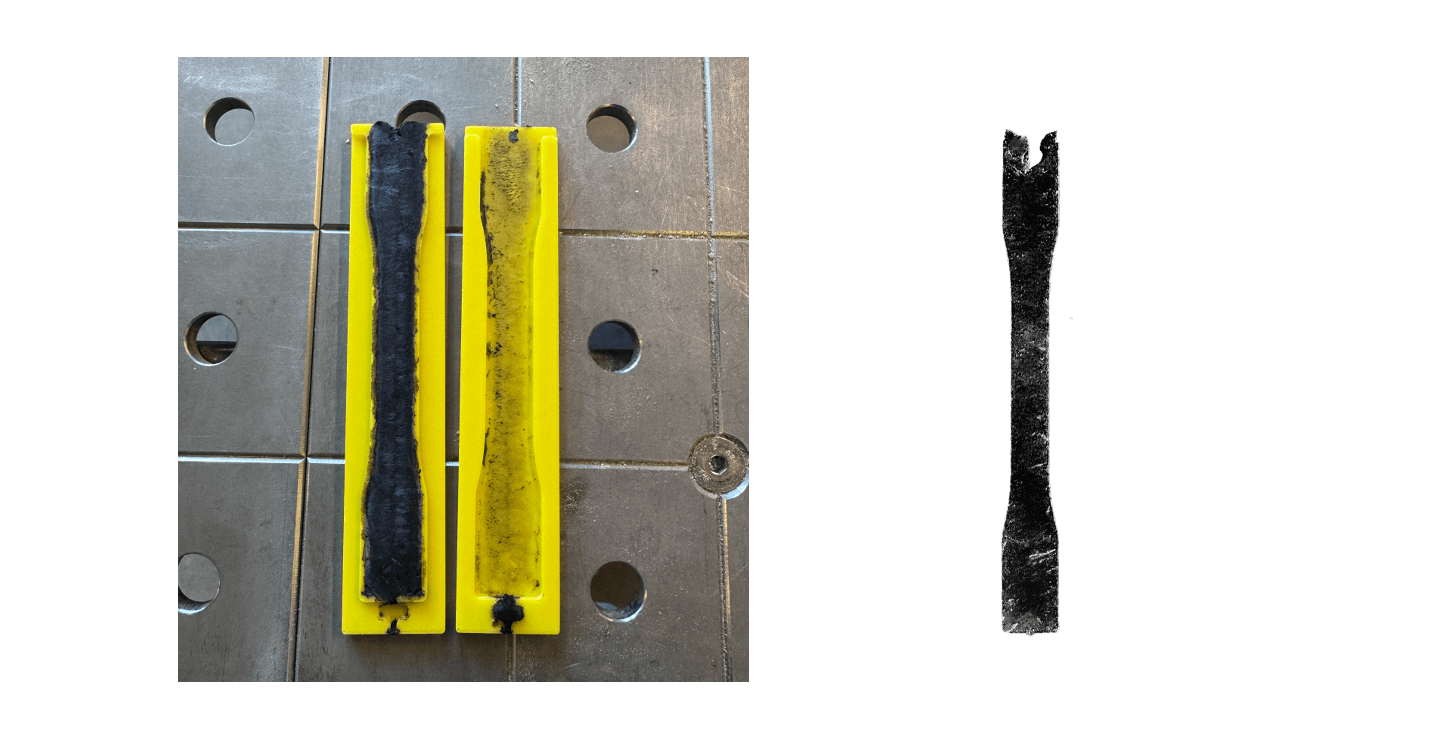
Flexible TPU molds were introduced after rigid molds caused specimens to fracture during removal.
TPU allowed the mold to deform during demolding, reducing stress concentrations and improving specimen recovery compared with rigid mold systems.
Multiple TPU mold iterations were produced as the geometry and casting process continued to develop.
06
Material Flow
Mold geometry was modified to control filling, excess material, and trapped air during casting.
Lead-In + Lead-Out
Features added to guide material flow.
Over-Pour
Additional regions provided space for excess material.
Venting
Pockets introduced to reduce air entrapment.
Together, these changes improved filling behaviour and reduced internal void formation within the specimens.
TPU nevertheless had limited durability under repeated thermal and mechanical loading. Progressive deformation reduced dimensional accuracy and introduced surface artifacts into later casts.
07
Compression Casting
The process returned to horizontal casting, combining over-pour geometry with hydraulic compression.
Excess material was intentionally introduced into the mold and then compressed using the hydraulic press.
Compression increased contact between the lignin and mold surfaces, reduced void formation, and improved density throughout the specimen. Pressure became an active part of the forming process rather than the mold acting only as a container.
Over-Pour
Hydraulic Compression
08
Mold Surface Testing
Different rigid mold interfaces were tested to balance thermal performance, surface quality, and demolding.
Stainless Steel + Aluminum
Strong lignin adhesion remained even with release agents.
PETG + PLA
Easier to fabricate, but also unable to prevent adhesion during repeated casting.
Metal plates were initially attractive because their high thermal conductivity could distribute heat across the sample. Adhesion, however, remained a significant limitation.
Testing these interfaces led to the development of a layered mold system that combined rigid alignment components with a flexible casting interface.
09
Hybrid Mold Assembly
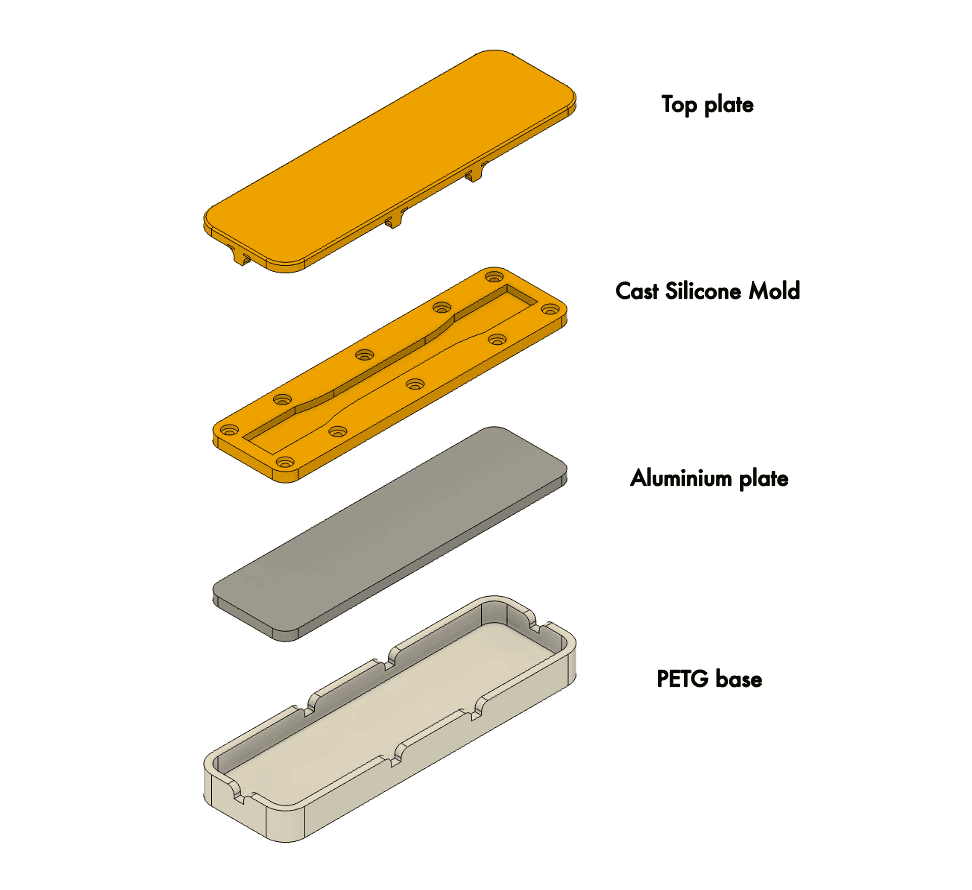
The mold evolved into a layered assembly combining rigid alignment, aluminum heat sinks, and a flexible interface.
Base
3D Printed PETG
Thermal Components
Aluminum Plates
Flexible Interface
Silicone
Mold Inserts
3D Printed + CNC-Milled Aluminum
The PETG base aligned and constrained the assembly while aluminum plates acted as heat sinks during forming. A flexible silicone interface and secondary aluminum plate completed the layered system.
This combination improved heat distribution while maintaining consistent pressure across the specimen.
10
Final Mold System
Silicone ultimately replaced TPU as the primary flexible mold material for repeated casting.
Silicone provided improved resistance to repeated thermal and mechanical loading. It maintained dimensional stability over multiple casting cycles, reducing deformation and extending mold lifespan.
Rigid inserts produced through 3D printing and CNC-milled aluminum components were used to control specimen geometry while the silicone provided reliable demolding.
Rigid Structure
PETG + Aluminum
Flexible Interface
Silicone
11
Repeatable Specimens
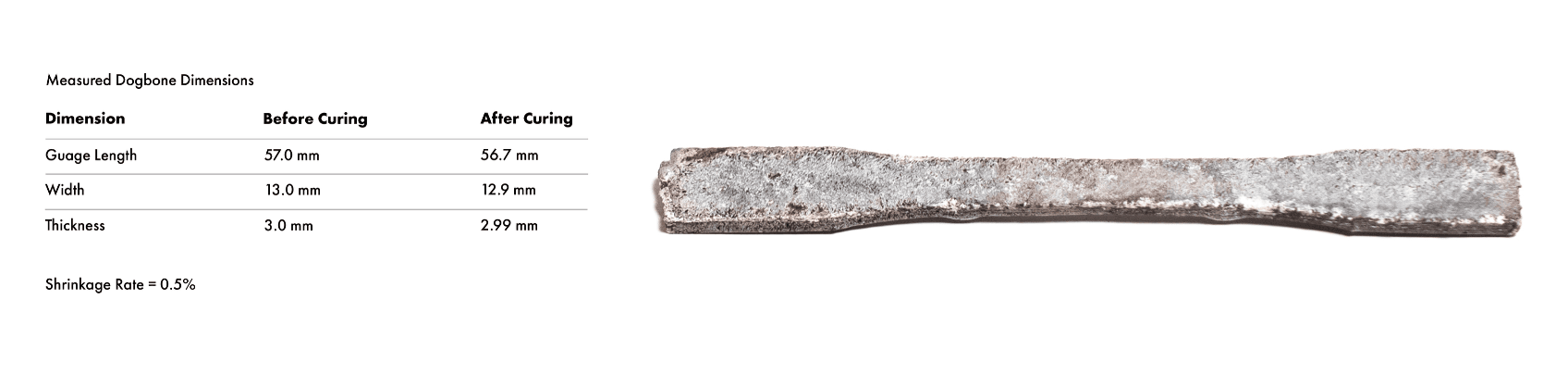
The final mold system provided the consistency required to produce standardized specimens for controlled mechanical testing.
Improved geometric control, demolding, thermal performance, and durability reduced variation introduced during specimen fabrication.
This allowed the testing process to focus more directly on changes in material behaviour rather than inconsistencies created by the casting system.
Main Research Project