Site under construction — check back daily for updates
Digital Fabrication
Digital Joinery for Irregular Materials
A digitally fabricated connection between reclaimed barn wood and found stone, developed through 3D scanning, geometric analysis, and robotic milling.
Type
Material +
Fabrication Research
Materials
Reclaimed Barn Wood
Found Stone
Process
Photogrammetry
Robotic Milling
Tools
UR10e
Sony FX3
Grasshopper
Collaborators
Annie Song · Liam Cassano · Eva Macoretta · Ryan Stanislaus
Type
Material +
Fabrication Research
Materials
Reclaimed Barn Wood
Found Stone
Process
Photogrammetry
Robotic Milling
Tools
UR10e
Sony FX3
Grasshopper
Collaborators
Annie Song
Liam Cassano
Eva Macoretta
Ryan Stanislaus
01
Material Origins
The project begins with two existing materials shaped by different histories: reclaimed barn wood and a found stone.
The timber was sourced from Rouge Park and had already passed through multiple material lives, first through natural growth and later as part of an agricultural structure. Grain, weathering, nails, and previous cuts remained visible across its surface.
The stone was collected from Woodbine Beach and presented a different set of conditions. Its irregular geometry, surface erosion, and weight became important constraints in determining how the two materials could meet.
02
Material Analysis
Existing material conditions were treated as design information rather than imperfections to be removed.
The timber was examined for grain direction, existing fasteners, weathered surfaces, and previous modifications. These conditions helped determine which areas could be machined and which should remain untouched.
The stone was studied through its existing geometry, surface condition, and weight. Rather than standardizing the material, these irregularities became constraints for developing its relationship with the timber.
03
Robotic Photogrammetry
A UR10e and Sony FX3 were used together to create a repeatable photogrammetry workflow for capturing the irregular material geometry.
The camera was mounted to the robot and moved through a sequence of predefined positions around the object. At each position the camera was triggered to capture an image, producing a controlled set of viewpoints for photogrammetric reconstruction.
The object was also rotated on a turntable, creating a collaborative scanning process between camera motion and object rotation. Using known robot positions made the capture sequence repeatable and helped simplify the alignment of the resulting scans.
04
Orientation Testing
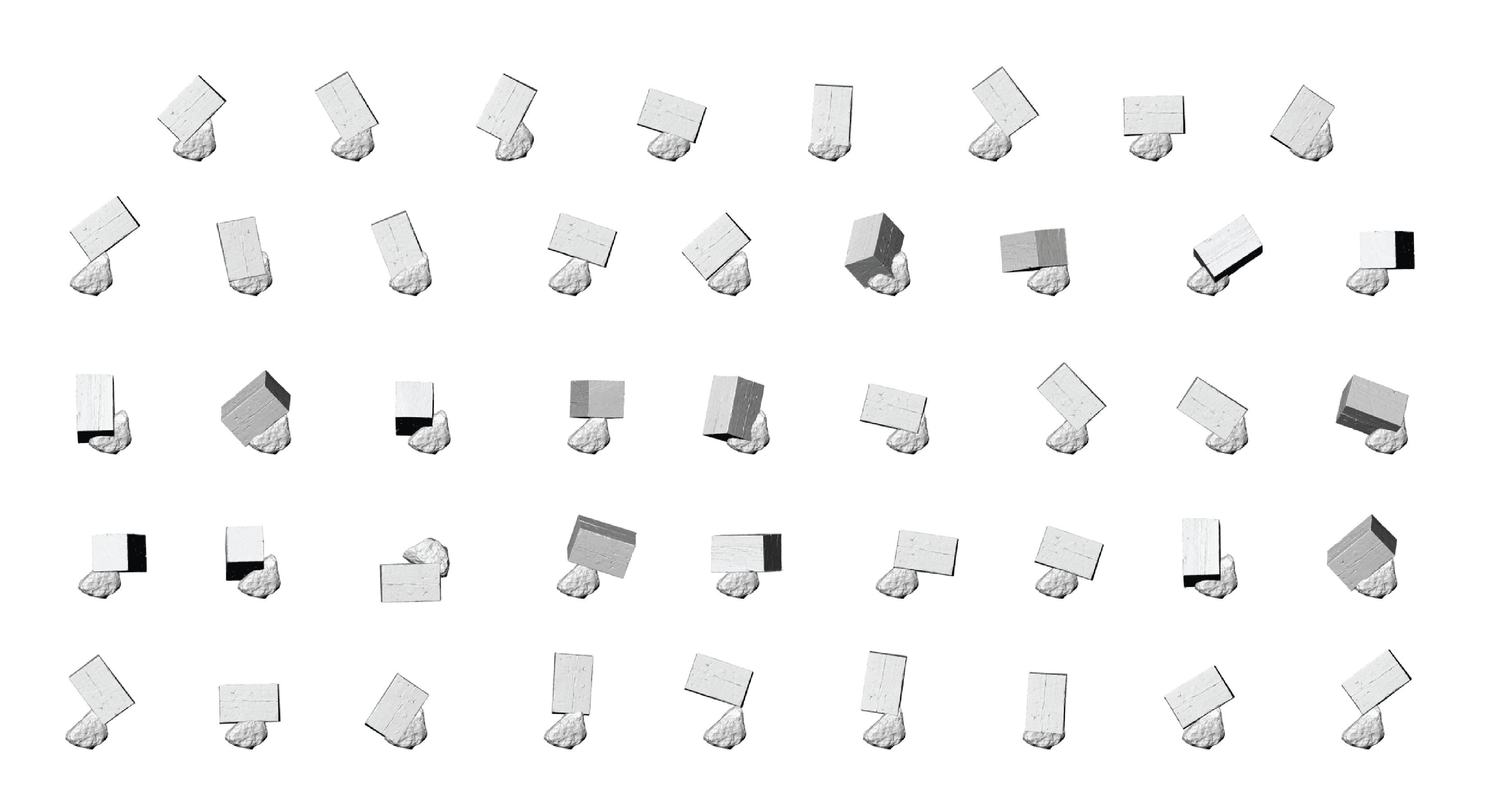
Multiple relationships between the timber and stone were tested to understand balance, stability, and the minimum contact required between them.
The scanned geometries allowed different orientations to be rapidly evaluated in a digital environment. Each iteration explored how the position of the timber changed its contact with the irregular surface of the stone.
Kangaroo physics simulations in Grasshopper were also used to explore the effect of weight and gravity on the assembly. This helped evaluate which configurations could balance using the stone as an anchoring mass before committing to fabrication.
05
Digital Connection
The connection was generated from the specific geometry of the two materials rather than imposed as a predefined joint.
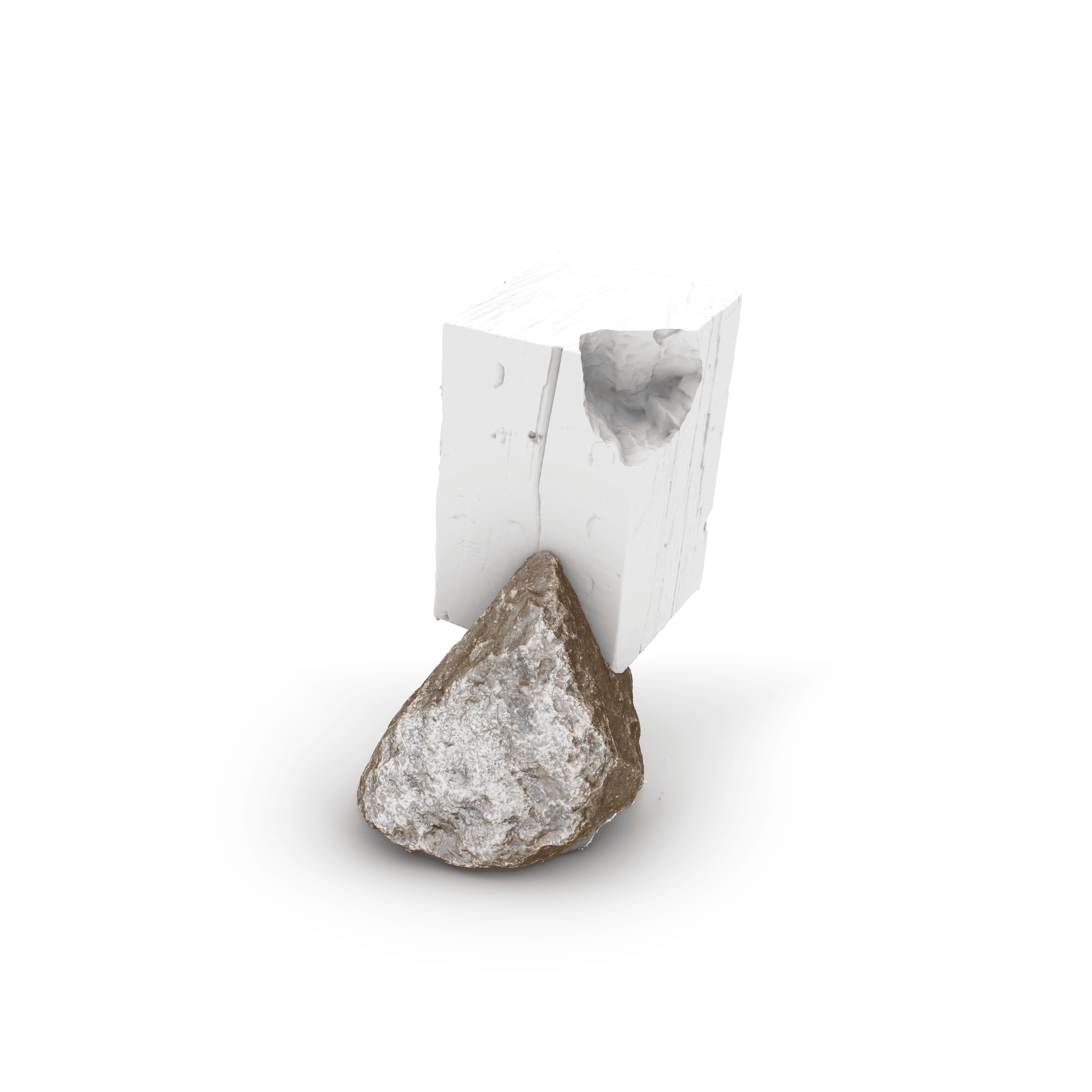
Once the final orientation was established, the scanned geometry of the stone defined the corresponding cut within the timber. The joint was therefore developed from the actual contact condition between the two irregular materials.
Digital fabrication acts as the mediator between the two pieces, translating their natural irregularities into a precise shared geometry without requiring either material to first become standardized.
06
Robotic Milling
The digitally generated connection was transferred back into the reclaimed timber through robotic milling.
Material was selectively removed from the timber to produce the contact geometry derived from the scanned stone. The machining operation was localized around the joint rather than used to regularize the entire piece.
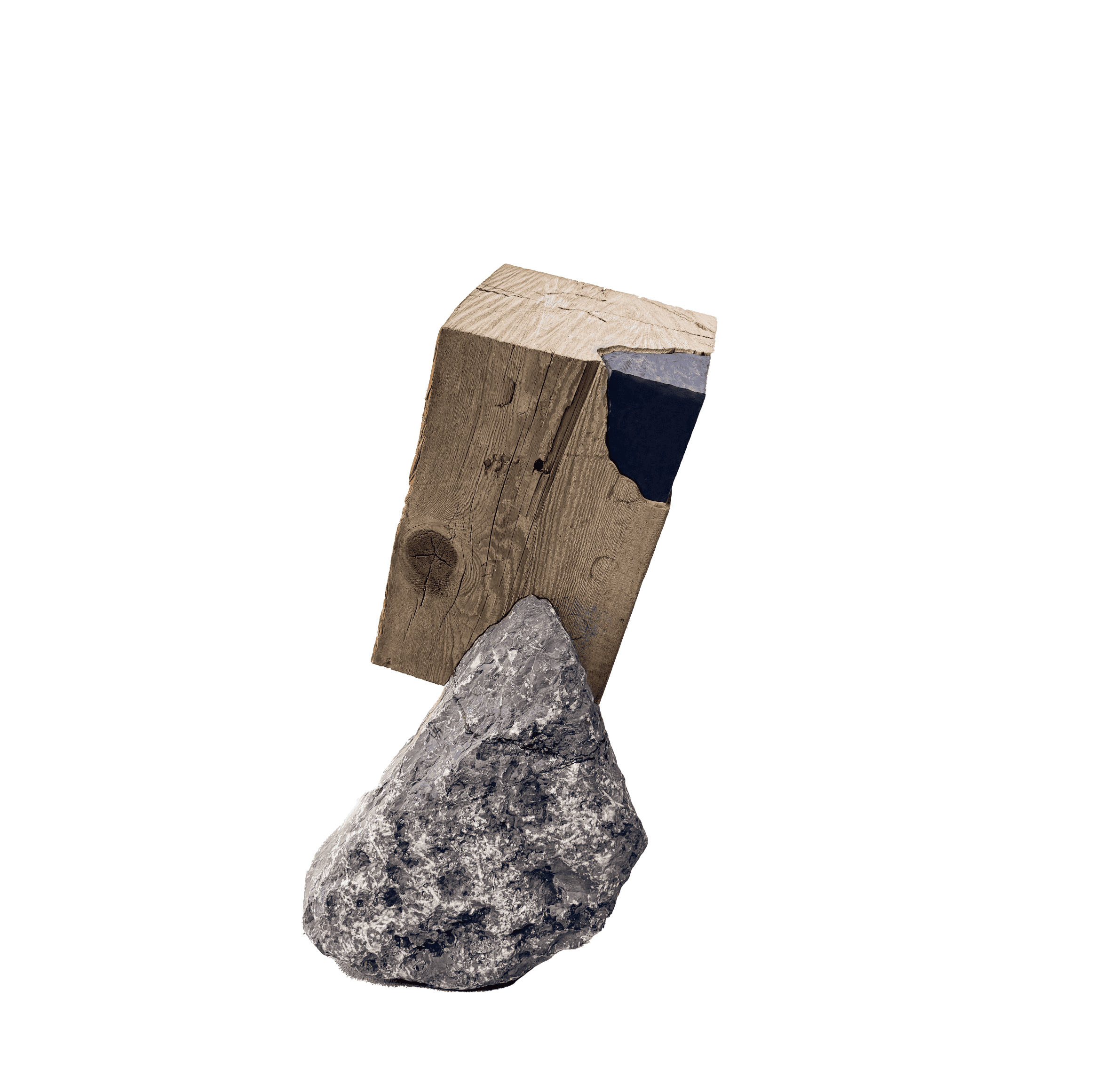
This preserved the existing character of the reclaimed timber while introducing a precise machined surface only where required for the two materials to connect.
07
Artificial Equilibrium
The final assembly relies on a precisely machined relationship between two materials that otherwise share no standardized interface.
The timber is cut only where required to establish the connection, allowing the weight and geometry of the stone to anchor the assembly while the wood remains standing freely.
The finished object retains evidence of both existing material histories and new fabrication. Weathered grain, erosion, and previous use remain visible alongside the machined surface that makes their connection possible.