Site under construction — check back daily for updates
Machine Development
CNC Wire Machine
A custom desktop machine developed to automate the preparation of breadboard wire through integrated feeding, bending, stripping, and cutting.
Type
Automated Machine
Year
2022
Period
High School
Controller
Arduino Mega
Actuation
Stepper + Servo Motors
Development
Mechanical Design
Electronics + Software
Project Context
Completed during high school as part of the Advanced Computer Engineering School program at Royal St. George's College.
01
Machine Overview
Developed as an alternative to pre-cut breadboard wire kits, CNC Wire brings the repetitive operations required to prepare wire into a single programmable machine.
The project was developed through three interconnected stages: design, software, and assembly. The mechanical system was designed around the complete wire preparation process rather than a single operation.
Continuous wire is moved through a sequence of feeding, bending, stripping, and cutting operations. Mechanical design, electronics, software, and fabrication were developed together within one compact machine.
02
System Development
The machine was developed around the movement of continuous wire through a sequence of discrete mechanical operations.
01 / Feed
A bipolar NEMA 17 stepper drives the wire forward and backward through the machine, controlling the amount of material delivered to the bending and cutting assembly.
The motor was selected for the torque required by the feeding stage and is controlled through a SparkFun EasyDriver V4.
02 / Bend
A smaller 24V unipolar stepper drives the bending mechanism, allowing the motor to fit within the constrained geometry of the forming head.
03 / Cut + Strip
Servo actuation operates the cutting and stripping mechanism positioned within the central forming assembly.
Components
Qty.
NEMA 17 Stepper Motor
1
25g Servo
1
24V Stepper Motor
1
SparkFun EasyDriver V4
1
2.8" TFT Display
1
Rugged Metal Pushbuttons
2
Emergency Stop
1
Incandescent Indicator
1
Barrel Jack
1
12V 2A Power Supply
1
LM7805 Voltage Regulators
2
Arduino Mega + Custom PCB
1
M4 Hardware + Wiring
03
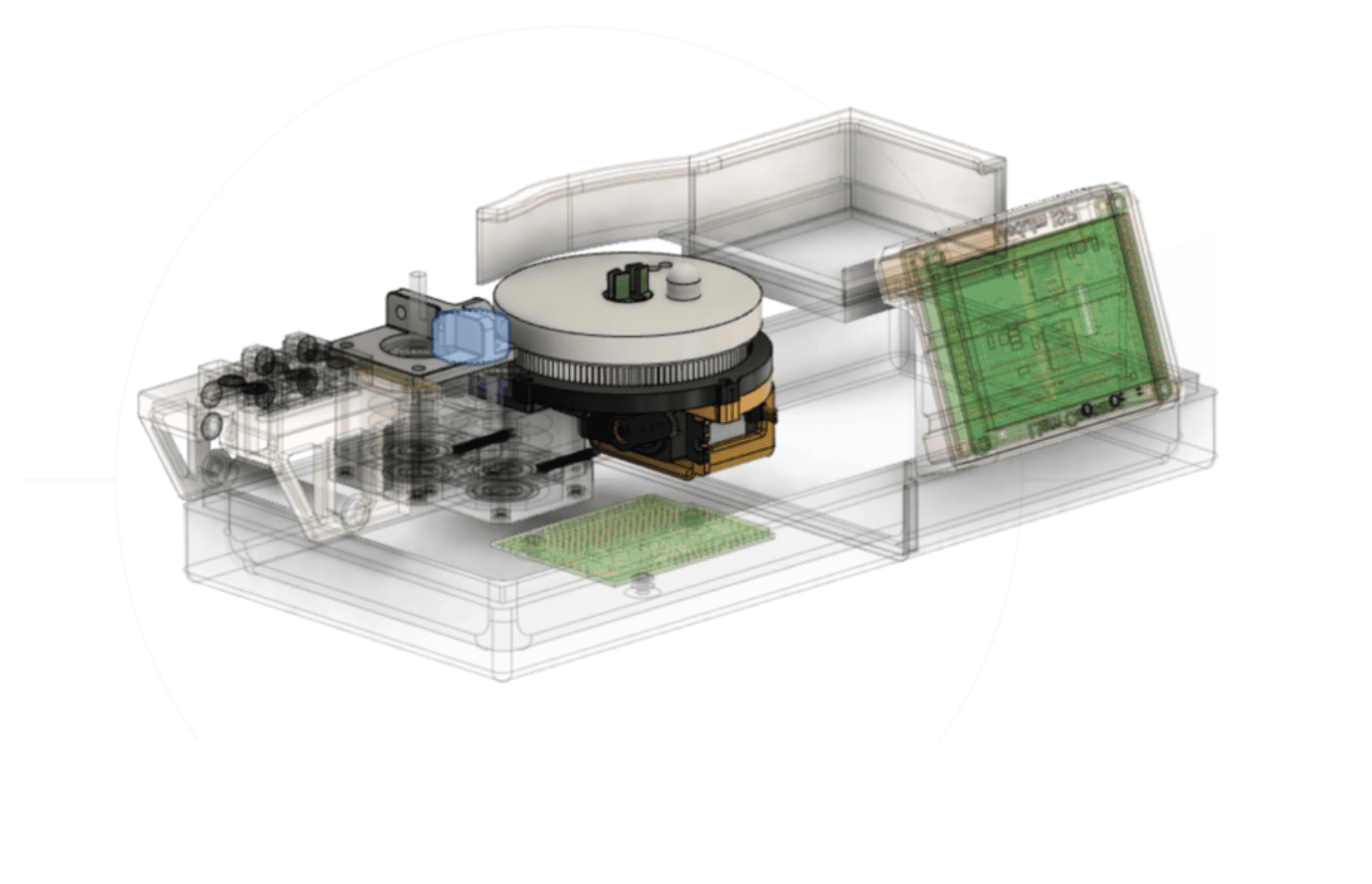
Bending + Cutting
Bending, stripping, and cutting were concentrated around a single compact forming head.
The main bending mechanism rotates around a central hub. A small-to-large gear ratio connects the rotating assembly to the compact unipolar stepper motor positioned beneath the mechanism.
Side cutters pass through an opening in the central hub, with the cutter jaws positioned between four guide pieces. A 25g servo mounted underneath the assembly operates the cutters through a custom metal linkage.

Bending and cutting mechanism development
CNC Wire Machine
04
Electronics + Control
A custom electronic control system connects the mechanical operations of the machine through a single Arduino-based architecture.
Custom PCB
The electronics were consolidated onto a custom PCB. The original prototype used dual TB6612 MOSFET drivers to control the two stepper motors, with the board assembled through hand-soldered components.
Power Distribution
Power enters through the PCB and is divided into 12V and 5V using two onboard voltage regulators, supplying the different electrical requirements of the motors and controller.
Interface
A 2.8-inch TFT display provides the primary graphical interface. Rugged metal pushbuttons, an emergency stop, and an incandescent indicator provide additional physical machine controls.
Embedded Software
The Arduino Mega coordinates the machine through dedicated functions for advancing, bending, and cutting the wire, turning the separate mechanical mechanisms into a programmed operating sequence.
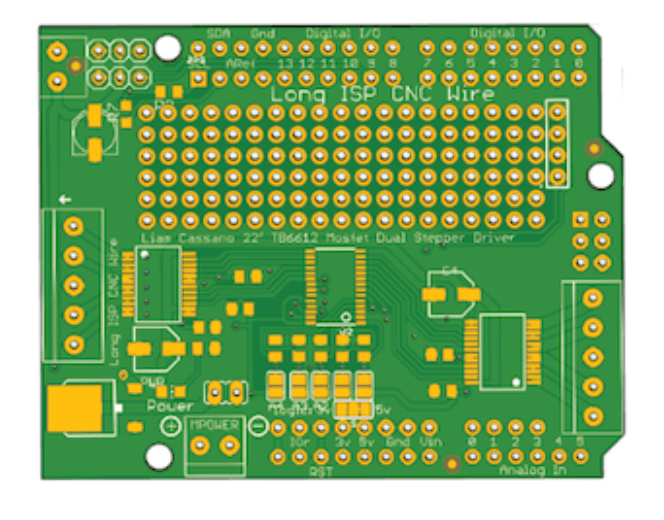
Custom PCB rendering
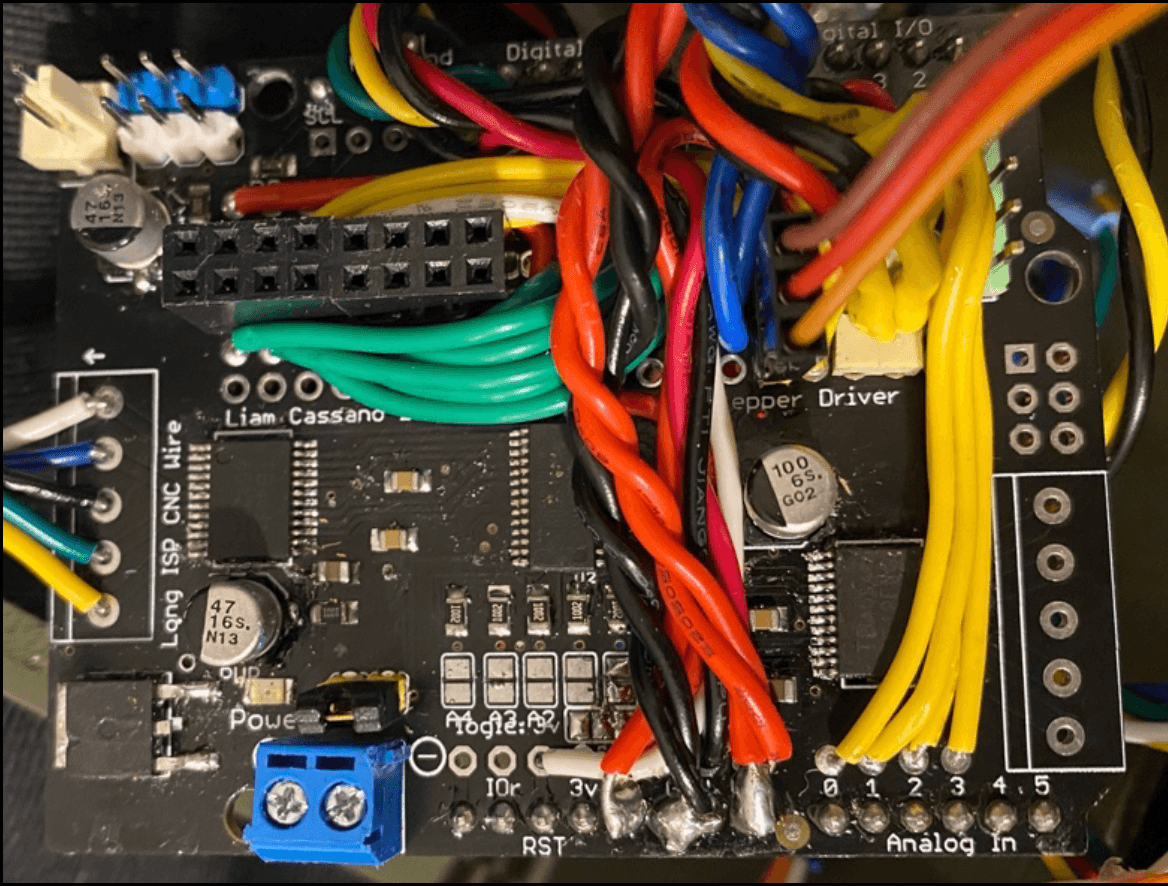
Hand-soldered PCB assembly
05
Programmed Operation
The mechanical operations are coordinated in software as a defined sequence rather than controlled independently.
01
Cut
02
Advance Wire
03
Bend 90°
04
Advance Wire
05
Bend 90°
06
Final Advance + Cut
06
Final Machine
CNC Wire brings mechanical design, custom electronics, embedded programming, interface design, and digital fabrication together within a single working machine.
The external housing was developed around the internal mechanical and electronic architecture, providing mounting points for components on both the inside and outside of the machine.
The completed prototype was developed as a usable tool for producing custom wire lengths for future electronics projects, consolidating a normally manual preparation process within a compact electromechanical system.